
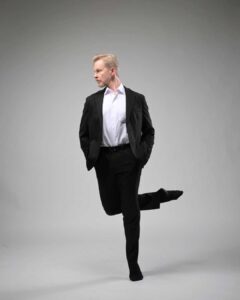
Technique Without Limits: Tiit Helimets Charts a New Course for Sacramento Ballet
With a career spanning continents and more than two decades at the pinnacle of the art form, Sacramento Ballet’s new Artistic Director arrives with clarity of purpose and a conviction that ballet’s greatest days are still ahead.
There are moments in the life of an arts organization when the appointment of a new leader signals not merely a change in personnel, but a genuine shift in possibility. Sacramento Ballet’s selection of Tiit Helimets as Artistic Director is one such moment. With an internationally distinguished career as a principal dancer, choreographer, and creative leader, and a depth of artistic conviction that is immediately apparent, Helimets arrives at a company with 71 years of history and an eye firmly trained on what comes next.
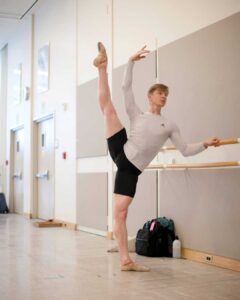 Born in Estonia and trained in the Vaganova tradition at its most rigorous, Helimets began his professional career with the Estonian National Ballet, earning a promotion to Principal Dancer in his very first season. From there, his path led to Birmingham Royal Ballet and ultimately to San Francisco Ballet, where he spent nearly two decades as one of the company’s most celebrated leading artists. Over the course of more than 27 years on stage, he performed principal roles in works by Helgi Tomasson, George Balanchine, Jerome Robbins, Kenneth MacMillan, Frederick Ashton, Christopher Wheeldon, Wayne McGregor, and Alexei Ratmansky, a repertoire that reads as a survey course in the history of ballet itself. He has been recognized with an Isadora Duncan Dance Award and Estonia’s Culture Capital Award, honors that reflect both the breadth and the excellence of his contributions to the art form.
Now, with the curtain rising on the 2026/27 season, Helimets speaks with the measured confidence of someone who has spent a career preparing for exactly this responsibility. “It felt like a place with both history and possibility,” he says of Sacramento Ballet. “There’s a foundation here, but also space to shape something meaningful going forward.” For him, the timing is as significant as the opportunity itself: “I’ve gathered a lot of experience over the years, on stage, in studios, working with different generations, and I feel ready to bring that together into a clear direction.”
Technique as Liberation
At the center of Helimets’s artistic vision is a philosophy that runs counter to the false choice so often posed between classical tradition and contemporary innovation. For him, the two are inseparable, and the attempt to pit them against one another represents a fundamental misunderstanding of what ballet is and how it evolves.
 “I want to build a company where classical technique is the foundation, but not the limitation,” he explains. “Technique should open possibilities. It should give dancers the ability to do more, not less.” His training in the Vaganova method, one of the most demanding and structurally rigorous systems in the world, instilled in him a deep reverence for clarity, precision, and intentionality in movement. But it also gave him something more: a framework expansive enough to accommodate genuine artistic evolution. “Working across different countries expanded that perspective,” he reflects. “It showed me how adaptable ballet can be, and how it continues to evolve.”
This conviction shapes not only how Helimets thinks about repertoire, but how he approaches the very act of creation. “The strongest contemporary work often comes from a deep understanding of classical technique,” he says. “Without that foundation, movement can become generic.” The implication is clear: at Sacramento Ballet under his leadership, the classics will not be treated as museum pieces, nor will contemporary work be pursued as a departure from tradition. Both will spring from the same well.
A Choreographer’s Eye
Helimets brings to his new role not only the perspective of a celebrated performer, but the lens of a working choreographer. His full-length reimagining of Giselle for Oregon Ballet Theatre demonstrated his ability to inhabit canonical works with fresh eyes, finding what remains essential and illuminating it anew. He has also created original works for Estonian National Ballet and San Francisco Ballet School, and his recent staging of Nureyev in Europe marked a significant expansion of his international creative presence.
“I’m very interested in work that grows out of classical vocabulary and evolves it into something contemporary and relevant,” he explains. “And also re-examining classical works, giving them a new light without losing their essence.” When asked where he begins when creating, his answer is elemental: “Often with structure and music. From there, movement starts to develop naturally.” It is a process rooted in discipline but animated by curiosity, and it reflects a creative sensibility that will bring both rigorous craft and genuine discovery to Sacramento’s stages.
As a collaborator, Helimets is drawn to artists who share his belief in the integrity of the craft. “I’m interested in people who understand structure and craft, who work with dancers, not just on them.” It is a distinction that says much about the kind of artistic culture he intends to build.
Leadership From the Inside
What distinguishes Helimets’s leadership, perhaps above all else, is the perspective he carries from decades on the other side of the studio mirror. “It gives me perspective,” he says of his performance career. “I understand what it feels like to be on stage, to struggle, to grow. So I approach dancers with both high expectations and understanding.”
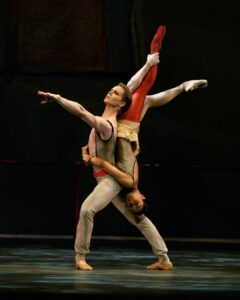 His leadership style is, by his own description, “clear, direct, and supportive,” a combination that demands commitment while creating the conditions in which dancers feel genuinely empowered to take risks and develop their own artistry. “When dancers have a strong foundation,” he explains, “they can start to explore and develop their own voice within it.” Structure, in Helimets’s vision, is not a constraint. It is the very thing that makes freedom possible.
That philosophy extends to his broader vision for the company’s culture. “A healthy artistic environment is focused, respectful, and open,” he says. “A place where people are working hard, but also feel supported and heard.” He values honesty and engagement above all: not just executing steps, but thinking deeply about what the work means and why it matters.
Innovation, Inclusion, and Community
Helimets’s record beyond the stage is equally compelling. As Co-Lead of San Francisco Ballet’s Inclusion Advisory Group, he guided institutional initiatives in equity, education, and inclusive programming, work that reflects his belief that the art form grows when more perspectives are brought into it. “It becomes richer and more relevant,” he says simply. And during the uncertainty of the COVID-19 pandemic, he conceived and produced Sequentia, a collaborative dance film uniting artists from major American companies. The project demonstrated both his resourcefulness and his commitment to expanding the reach of ballet beyond traditional boundaries.
In Sacramento, that commitment to community will take on new dimensions. Helimets envisions the company as both a cultural presence and a point of connection, not just performing, but engaging with the community in a meaningful way. He speaks of opening doors through partnerships with schools and artists, of creating opportunities for people who want to be part of the theatrical world but may not yet have found their way in. “Even small opportunities can make a big difference,” he says.
What Sacramento Can Expect
As he prepares for his inaugural 2026/27 season at the helm, Helimets is focused on something both specific and expansive: establishing a clear artistic identity that audiences can recognize, connect with, and trust. “I want people to begin to understand what the company stands for,” he says. “That there is a clear sense of direction.”
 What they will find in his programming, in his process, and in the dancers he shapes is a ballet company grounded in the full weight of its art form’s history and animated by an equally serious commitment to its future. “Everything we do will come from a place of intention,” he promises. “Respecting where ballet comes from, while making sure it continues to grow and stay alive.”
Ballet, at its core, is for Helimets “a discipline that gives meaning to movement, not just steps, but the depth of training, the clarity, the intention behind what you’re doing.” It is that intention, precise, purposeful, and deeply felt, that Sacramento Ballet audiences will encounter in the seasons ahead. The foundation is strong. The vision is clear. And for Sacramento, the next chapter is only just beginning.
Photos 1,3 and 5 by Tony Nguyen. Photos 2 and 4 by Erik Tomasson.